[email protected] +1 (614) 555-0192
Request Quote

Vertiv Engineering Standards & Technologies

Deep-dive into the engineering principles, test methodologies, and compliance frameworks that underpin every Vertiv infrastructure product.

NEBS Level 3 Compliance Program

The Network Equipment-Building System (NEBS) standard defines the most stringent environmental and safety requirements for telecom equipment. Vertiv's NEBS Level 3 program covers three critical frameworks:

GR-63-CORE: Physical Protection

Seismic Zone 4 qualification (0.8g triaxial), fire resistance (Underwriters heat release), airborne contaminant testing, and transportation shock/vibration per ISTA 3A.

GR-1089-CORE: EMC & Electrical Safety

Lightning surge immunity (1,000V common-mode), AC power fault tolerance, EMI emissions per FCC Part 15 Class A, and ESD protection per IEC 61000-4-2.

GR-487-CORE: Electronic Equipment Enclosures

Structural integrity, thermal management, cable entry provisions, and maintenance access requirements specific to telecom enclosures.
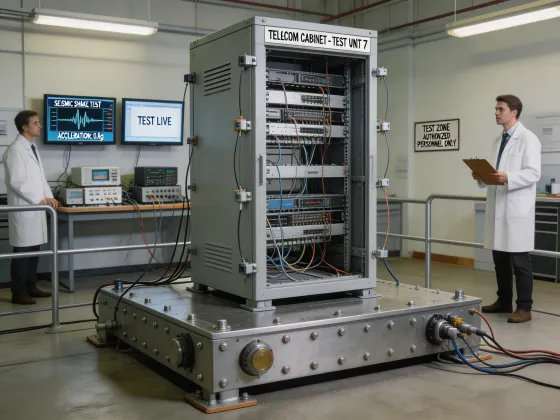
NEBS Level 3 seismic testing

IP67 Protection & Thermal Management

Vertiv enclosures are engineered to maintain equipment operating conditions in harsh outdoor environments, with every specification backed by third-party test data.

Parameter Specification Test Standard
IP Rating IP67 (dust-tight, 1m immersion) IEC 60529
Operating Temperature -40°C to +65°C Telcordia GR-487
Salt Spray Resistance 2,000+ hours ASTM B117
UV Resistance 5,000+ hours accelerated ASTM G154
Wind Load 200 km/h sustained ASCE 7-22
Seismic Rating Zone 4 (0.8g triaxial) GR-63-CORE
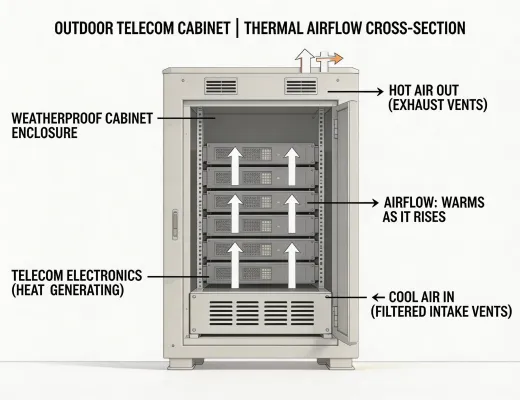
Thermal management system cross-section

The hybrid cooling systems combine filtered forced-air ventilation with optional heat exchangers, maintaining internal temperatures within 10°C of ambient under full equipment load (tested at 4,000W dissipation, 40°C ambient). Smart thermal controllers adjust fan speeds based on real-time temperature and humidity sensing, with SNMP monitoring integration for remote sites.

Modular Scalable Architecture

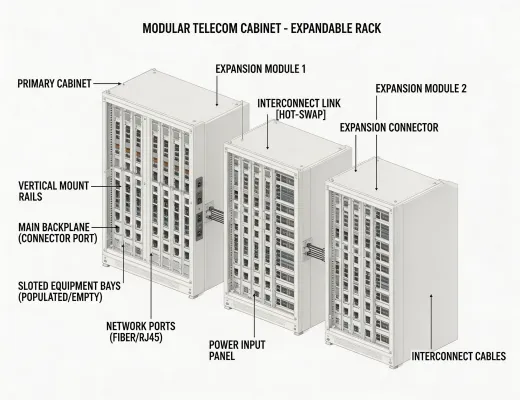
The patented quick-mount rail system eliminates the need for specialized tools during field upgrades. Start with a minimum viable configuration and expand incrementally as the network grows — using a single platform architecture across all deployment sizes.

  • Standard Bay Widths: 19-inch (482.6mm), 23-inch (584.2mm), ETSI (535mm)
  • Depth Options: 600mm, 800mm, 1000mm, 1200mm
  • Scalability: 2-cabinet to 12-cabinet configurations on same platform
  • Field Upgrade Time: Under 4 hours for bay extension with standard tools
  • Cable Capacity: Up to 10,000+ fiber cores per cable management system
Modular scalable cabinet architecture

Infrastructure Design Trade-offs

Selecting the right telecom infrastructure involves weighing competing priorities. These are the most common trade-offs network planners face when specifying enclosures and distribution systems.

Active vs. Passive Cooling Systems

Active cooling (compressor-based or thermoelectric) maintains tight temperature control regardless of ambient conditions, but increases energy consumption by 800-1,200W per cabinet and introduces mechanical components that require maintenance every 18-24 months. Passive cooling (filtered forced-air ventilation and heat exchangers) has lower operating costs and no compressor maintenance, but performance degrades when ambient temperatures exceed 45°C and humidity rises above 85% RH. For deployments in temperate climates with heat loads below 2,000W, passive cooling is typically sufficient. Desert, tropical, and equatorial sites with heat loads above 3,000W generally require active cooling despite the higher total cost of ownership.

Steel vs. Aluminum Enclosure Construction

Mild steel (1.5-2.0mm gauge) with powder coating remains the default for most telecom cabinets due to its lower material cost, superior EMC shielding effectiveness, and availability. However, aluminum (5052-H32 alloy, 2.0-3.0mm) reduces cabinet weight by 40-50%, which is critical for pole-mount and rooftop installations where structural load limits apply. The trade-off: aluminum costs 2.5-3x more per kilogram, offers weaker EMC shielding without additional gaskets, and requires specialized welding (TIG vs. MIG for steel). Galvanized steel with hot-dip zinc coating (ASTM A653, G90 minimum) provides a middle ground for corrosive environments at moderate cost, though it lacks the aesthetic finish of powder-coated options.

Performance Boundaries & Design Constraints

Transparent specification requires understanding where products perform optimally and where alternative approaches may be needed.

IP67 Immersion Limits

IP67 certification per IEC 60529 covers temporary immersion (1 meter depth for 30 minutes). It does not guarantee protection against sustained submersion or high-pressure water jets. Installations in flood-prone areas below the 100-year flood line should use elevated mounting platforms or specify IP68-rated enclosures for the lower compartments.

Thermal Capacity Ceiling

Standard forced-air cooling systems maintain internal temperatures within 10°C of ambient up to 4,000W heat dissipation at 40°C ambient. Above this threshold, or at ambient temperatures exceeding 50°C, compressor-based cooling becomes necessary, adding approximately $2,800-$4,500 to the cabinet cost and requiring a 120V/240V AC power supply that may not be available at all cell sites.

Seismic Bracing Weight Penalty

GR-63-CORE Zone 4 seismic bracing adds 15-25% to the base cabinet weight due to reinforced corner posts, cross-bracing members, and heavy-gauge anchor brackets. For rooftop installations with limited structural capacity, Zone 2 bracing (0.5g) may be acceptable per local building codes, reducing the weight penalty to 8-12%. Consult the structural engineer of record before specifying seismic zone requirements.

White Papers & Design Guides

NEBS Level 3 Compliance Checklist

A comprehensive guide to GR-63/GR-1089 requirements for telecom equipment enclosures, including test matrix and documentation templates.

Download PDF

Thermal Management Design Guide

Heat load calculation methodology, cooling technology comparison (forced air vs. heat exchanger vs. compressor), and sizing tables for outdoor enclosures.

Download PDF

Seismic Design for Telecom Infrastructure

Understanding seismic zone classifications, anchor bolt calculations, and bracing requirements for telecom cabinets per GR-63-CORE and IBC 2021.

Download PDF

Need Technical Specifications?

3D CAD files (STEP/IGES), thermal simulation reports, and full compliance documentation packages are available to support your specification process.

Talk to an Engineer